How does the واجهة الدماغ والحاسوب Hand روبوت إعادة التأهيل Work? - السكتة الدماغية Center
Imagine you are squeezing a rubber ball. Nothing happens-your fingers stay still.
Yet inside your skull, the motor-planning regions of your brain are already humming.
The Syrebo® BCI Hand روبوت إعادة التأهيل turns that silent hum into real movement: a soft robotic glove inflates, your curled fingers open, and a closed loop between brain and hand begins to re-wire itself.
Below is a plain-language tour of how this works, why it helps السكتة الدماغية or spinal-cord-injury survivors, and what the published evidence says.
1. The Brain's Quiet Song: Mu Rhythms & Motor Imagery(MI)
When you are relaxed, groups of neurons in the sensorimotor cortex fire together 8–13 times per second. That rhythm is called the mu wave (or sensorimotor rhythm, SMR).
The moment you imagine moving your right hand-even if it does not actually move-the rhythm on the left side of the brain weakens. This drop is called ERD (Event-Related Desynchronization). Different imagined movements leave different "fingerprints" of ERD across the scalp.
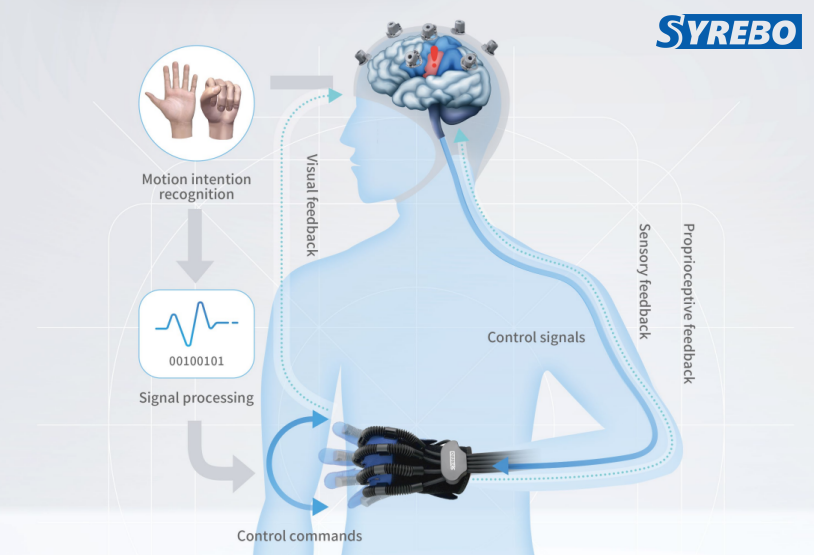
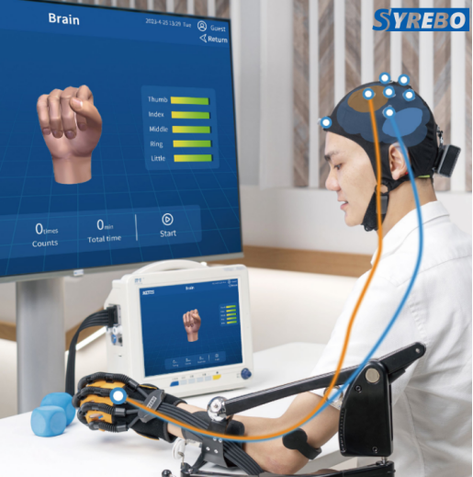
The Syrebo system records these tiny voltage changes through a comfortable EEG cap, figures out which hand you are thinking about, and tells the glove to move that hand in real time.
In short: The glove listens to your brain's signal, decode that signal into instruction , and turns that into motion with the assistance of the glove.
2. Hebb's Rule: "Fire Together, Wire Together"
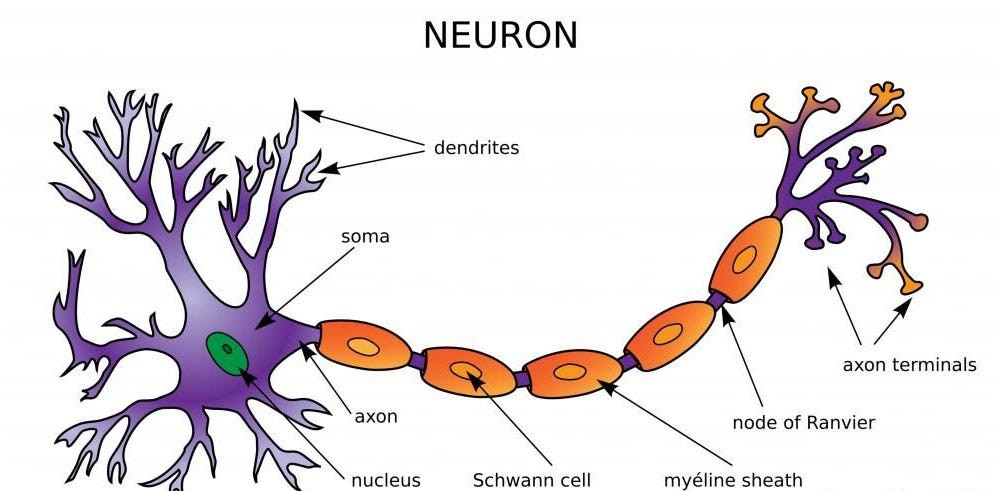
In 1949 Donald Hebb proposed that neurons that fire together repeatedly strengthen their connections.
Syrebo exploits this principle. Each time the glove opens because the imagined "open" command is detected, two things occur:
Sensory receptors in the skin and joints send a flood of "hand is opening" signals back to the brain.
The same neurons that issued the command receive immediate, congruent feedback.
After hundreds of repetitions, dormant or damaged pathways re-activate-a process called neuroplasticity.
3. Closing the Loop: "Central-Peripheral-Central" Therapy
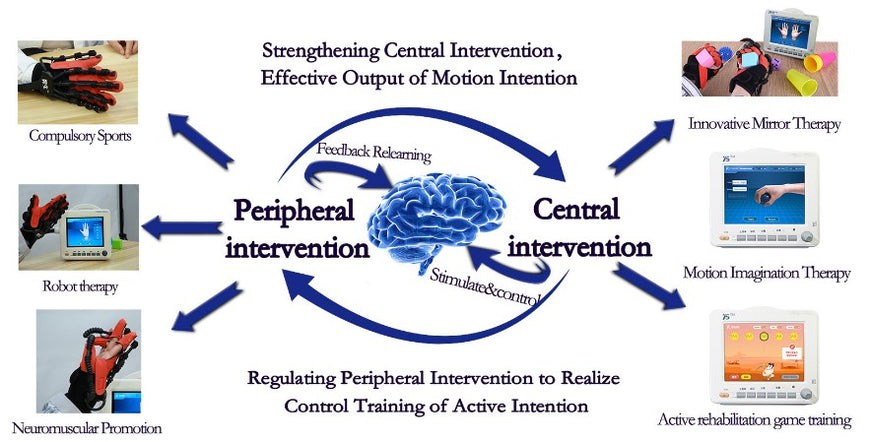
Traditional therapy often separates "brain training" (mental imagery) from "hand training" (passive stretching or functional tasks). Syrebo merges them into a single loop:
Central → Peripheral → Central
Central: EEG detects the intention (brain).
Peripheral: The glove produces the action (hand).
Central: Sensory feedback returns to reinforce the intention (brain again).
A 2022 meta-analysis of 235 patients showed that BCI-driven hand robotics produced significantly larger improvements in the Fugl-Meyer Upper-Extremity score than conventional robotics alone (Nojima et al., 2022).
4. Does It Really Work? Snapshots from Clinical Trials
|
Condition |
Study Details |
Key Outcome |
|
السكتة الدماغية (sub-acute) |
55 patients, 4-week training (Pichiorri et al., 2015) |
40 % reached the minimal clinically important difference on the Action Research Arm Test vs. 5 % in control. |
|
Chronic السكتة الدماغية |
3-week BCI-glove vs. mental imagery alone (Mihara et al., 2013) |
FMA-UE score improved by 7 points (BCI) vs. 1 point (imagery). |
|
Spinal cord injury |
8 paraplegic adults, 12-month BCI-driven الهيكل الخارجي (Donati et al., 2016) |
Partial restoration of voluntary leg control in all participants. |
5.From Thought to Motion: A New Beginning for Your Hand
Moving a paralysed hand used to require either spontaneous biological luck or invasive implants. Syrebo® offers a non-invasive shortcut: listen to the brain's intention, complete the action for it, and let neuroplasticity finish the rewiring.
Every journey begins with a single thought. If you or someone you love is facing the long road of hand إعادة التأهيل, know that science now stands ready to turn the quiet spark of intention into real, measurable progress. Each imagined movement, gently guided by Syrebo®, is a step toward reclaiming independence-one open hand, one grasp, one day at a time. Keep thinking it, keep believing it, and let your mind lead the way back to motion.
Further Reading (open-access)
Donati, A. R. C. et al. (2016). Long-term training with a brain-machine interface-based gait protocol induces partial neurological recovery in paraplegic patients. Scientific Reports, 6, 30383. https://doi.org/10.1038/srep30383
Nojima, I., Sugata, H., Takeuchi, H., & Mima, T. (2022). واجهة الدماغ والحاسوب training based on brain activity can induce motor recovery in patients with السكتة الدماغية: A meta-analysis. Neurorehabilitation and Neural Repair, 36(2), 83-96. https://doi.org/10.1177/15459683211062895
Mihara, M., Hattori, N., Hatakenaka, M., Yagura, H., Kawano, T., Hino, T., & Miyai, I. (2012). Neurofeedback using real-time near-infrared spectroscopy enhances motor imagery related cortical activation. PLOS ONE, 8(3), e59326. https://doi.org/10.1371/journal.pone.0032234
Pichiorri, F., Morone, G., Petti, M., Toppi, J., Pisotta, I., Molinari, M., Paolucci, S., Inghilleri, M., Astolfi, L., Cincotti, F., & Mattia, D. (2015). Brain–computer interface boosts motor imagery practice during السكتة الدماغية recovery. Annals of Neurology, 77(5), 851–865. https://doi.org/10.1002/ana.24390