Clinical Research Collection | A wearable EEG-based Assistive BCIs System for إعادة تأهيل السكتة الدماغية - السكتة الدماغية Center
Research background
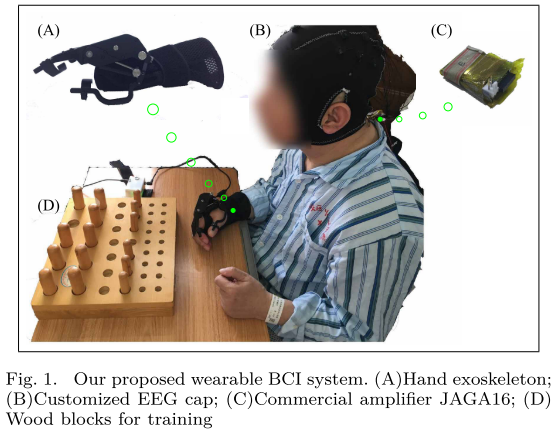
The combination of BCI and auxiliary robot is a new treatment for إعادة تأهيل السكتة الدماغية. However, most of the existing study is based on complex system setups, expensive and bulky equipment. In this study, a wearable EEG واجهة الدماغ والحاسوب system for hand function إعادة التأهيل is designed to do clinial trial. This system is composed of customized EEG cap, commercial amplifier, and hand الهيكل الخارجي. In addition, the system includes the visual interface for the convenience of users. The trial enrolled six healthy participants and two السكتة الدماغية patients to verify the safety and effectiveness of the system.
Method
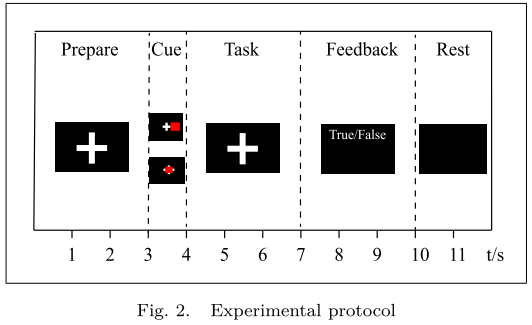
To verify the safety and effectiveness of the system, 6 healthy subjects(1 female and 5 males, aged 23±3 years old) from Shanghai Jiao Tong University and 2 السكتة الدماغية patients(all right hand affected) from the إعادة التأهيل department of Huashan Hospital were recruited to participate in the study. A 6-minute training session was conducted for each subject, in which the subjects performed right-hand motor execution(السكتة الدماغية patient’s affected hand to make a movement attempt) according to visual cues. A red rectangle appears on the right or center of the screen, indicating action execution (or attempt) or rest, respectively. The task lasts for 4 seconds until the white cross disappears. It is recommended that healthy subjects repeat clenching and extending fists 3-4 times, and السكتة الدماغية patients are instructed to make motor attempts during motor tasks. The online test was similar to the training session, except that all red rectangles appeared in the center of the screen, which allowed subjects to choose to move their hand (or exercise attempt) or rest at will. Test results are provided to users visual and proprioceptive feedback via a screen and hand الهيكل الخارجي shortly after task completion. There are three online test runs, each containing 20 trials. Each subject may rest between runs. All subjects were asked to refrain from any additional facial or arm muscle movement throughout the experiment.
Result
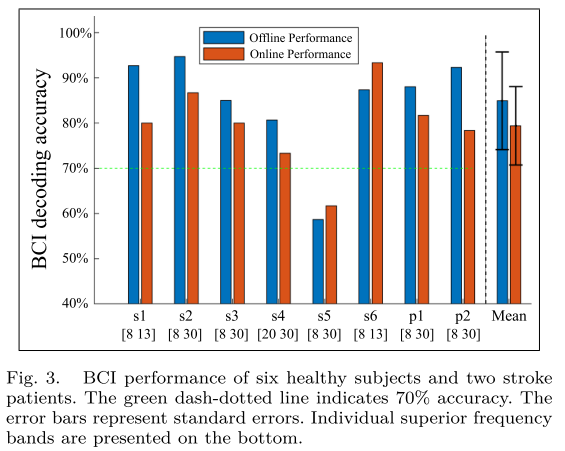
The average accuracy of offline and online training is 84.91% and 79.38%, respectively. Seven subjects had online accuracy of more than 70%, five more than 80%, and one more than 90%.
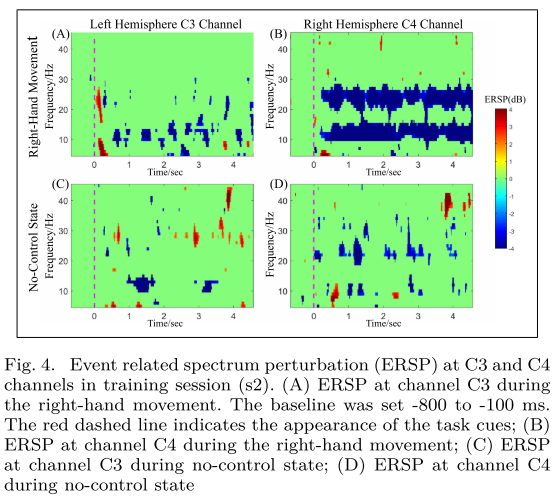
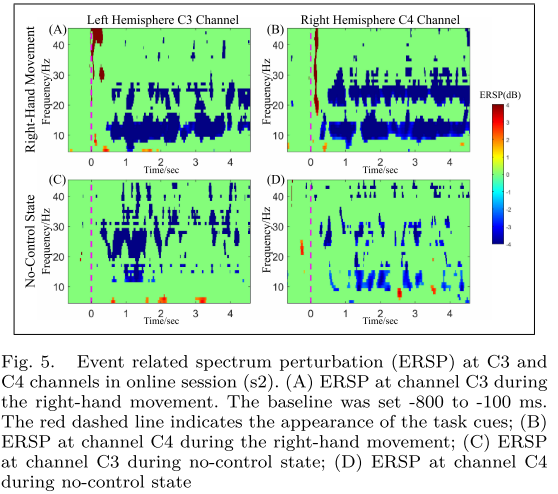
The Event-related Spectral Perturbation(ERSP) showed that the sensorimotor cortex was activated in both α and β bands during right hand movement training, with stronger activation on the same side. Meanwhile, as expected, the uncontrolled state showed no significant activation on either the C3 or C4 channels. In the online test, both the left and right hemispheres were activated to perform right-handed movements.
Conclusion
This study demonstrates a wearable واجهة الدماغ والحاسوب system for hand function إعادة التأهيل after السكتة الدماغية. The results of motor task differentiation preliminarily confirm the feasibility of this device, which shows great clinical application potential.
Reference: Qin Z, Xu Y, Shu X, et al. eConHand: A Wearable واجهة الدماغ والحاسوب System for إعادة تأهيل السكتة الدماغية[C]// 2019 9th International IEEE/EMBS Conference on Neural Engineering (NER). IEEE, 2019.