A Meta-Analysis: The Effect of واجهة الدماغ والحاسوب(BCI) on Upper Limb إعادة التأهيل after السكتة الدماغية - السكتة الدماغية Center
Introduction
Motor إعادة التأهيل after السكتة الدماغية is now fast-growing, driven by other technological fields such as virtual and augmented reality (VR/AR), robotics, and invasive and non-invasive واجهة الدماغ والحاسوب (BCI). BCI can provide real-time sensory feedback of EEG activity, enabling السكتة الدماغية patients to regulate their sensorimotor rhythms consciously. In typical noninvasive, EEG-based BCI, the user's motor intention (motor imagery or execution) is decoded from the brain's electrical activity in real-time by extracting relevant features. The detection of motion intention by BCI will trigger the corresponding sensory feedback to the user. This feedback can be in abstract form (such as a cursor moving on a computer screen) or in the form of concrete feedback (such as a visual representation of a participant's body parts on a virtual avatar, or superimposed directly on a participant physically) or somatosensory delivery via robotic, tactile, or neuromuscular electrical stimulation (NMES) systems to reproduce intended movements, which has been shown to enhance motor learning.
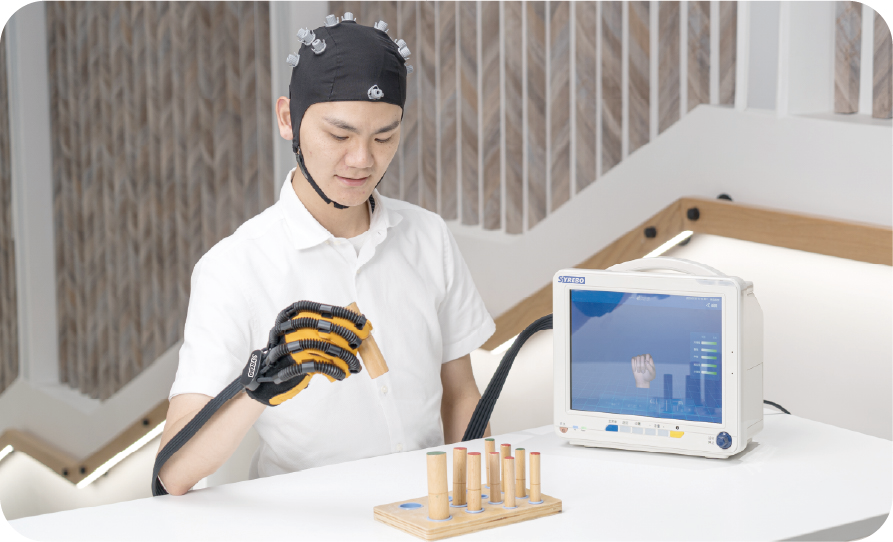
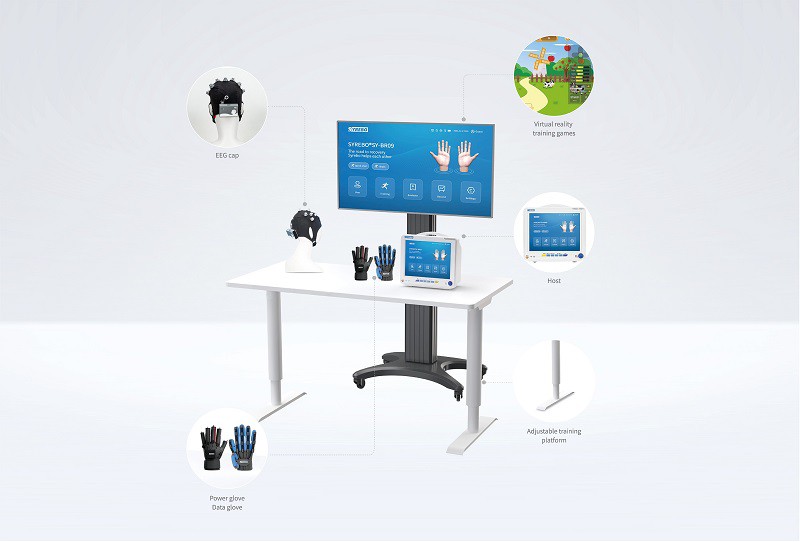
The واجهة الدماغ والحاسوب has begun to be used in إعادة التأهيل after السكتة الدماغية. It aims to promote neuroplasticity by adjusting or self-regulating neurophysiological activities, thereby improving the effect of إعادة التأهيل. However, there are still uncertainties about its actual clinical efficacy. This article aims to quantify the effectiveness of BCI training in upper limb إعادة التأهيل after السكتة الدماغية by conducting a meta-analysis of existing randomized controlled trials (RCTs). Changes in motor function at the beginning and end of the intervention were reported in these RCTs. The investigators reviewed available reports from all RCTs using these techniques. They provided pre- and post-intervention dyskinesia scores for the experimental and control groups, which included standard therapy, robotic therapy, electrical stimulation, and motor imagery without BCI.
Methods
MEDLINE, CENTRAL, PEDro, and other databases were used, and the literature was screened by checking the references of multiple review articles. Randomized controlled trials using BCI for post-السكتة الدماغية motor إعادة التأهيل were selected, and motor disorder scores before and after intervention were provided. Summary effect sizes were calculated using the random-effects inverse variance method. Initially, 524 articles were found, and after removing duplicates, the titles and abstracts of 473 articles were screened. Finally, 26 articles corresponding to BCI clinical trials were found, of which 9 studies involving a total of 235 السكتة الدماغية survivors met the inclusion criteria for meta-analysis (randomized controlled trials with motor performance as the outcome index).
Results
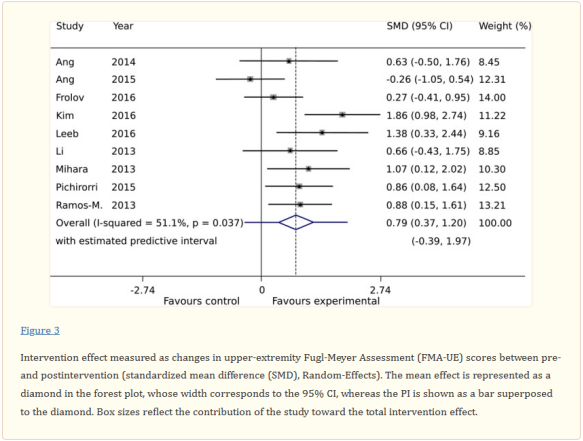
In 6 BCI studies, motor improvement, mainly quantified by upper extremity Fugl-Meyer assessment (FMA-UE), exceeded the minimal clinically important difference (MCID=5.25), while this improvement was achieved in only 3 control groups. Overall, the standardized mean difference between BCI training and FMA-UE compared with the control condition was 0.79 (95% CI: 0.37 to 1.20), within the range of moderate to large pooled effect sizes. Furthermore, several studies have shown that BCI induces functional and structural neuroplasticity at subclinical levels.
Conclusions
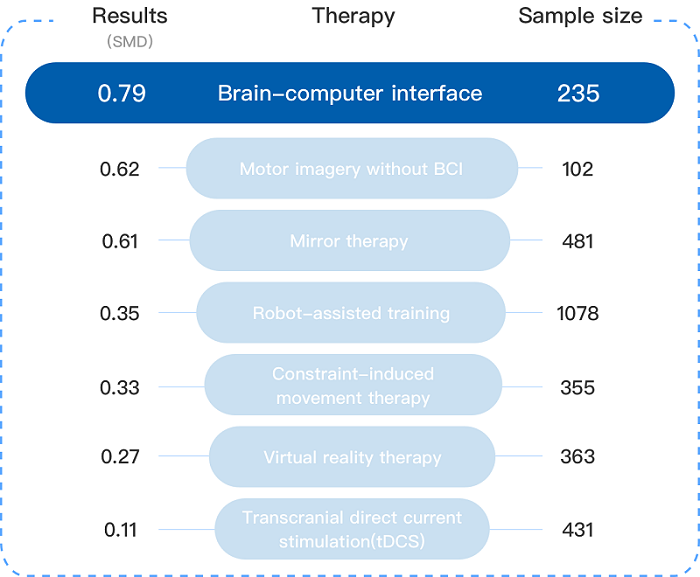
واجهة الدماغ والحاسوب-based neurorehabilitation shows moderate to large effect size on upper limb motor function, which is superior to conventional إعادة التأهيل treatments such as motor imagery, العلاج بالمرآة, robot-assisted training, constraint-induced movement therapy, virtual reality therapy, and tDCS. In addition to motor outcomes, several studies have reported subclinical levels of functional and structural neuroplasticity induced by BCI, some of which correlate with improved motor outcomes. More studies with larger sample sizes are needed to improve the reliability of these results.
Reference: Cervera MA, Soekadar SR, Ushiba J, et al. Brain-computer interfaces for post-السكتة الدماغية motor إعادة التأهيل: a meta-analysis. Ann Clin Transl Neurol. 2018 Mar 25;5(5):651-663.