6 Stages of السكتة الدماغية Recovery and the Targeted Training for Each stage - السكتة الدماغية Center
Once السكتة الدماغية strikes, 90% of survivors with الشلل النصفي will have upper limb dysfunction and lose self-care ability. Most patients know that early إعادة التأهيل treatment can restore the motor function of limbs as soon as possible; however, it is not clear to patients what process will they go through and what exercise is effective in each stage. So, to better understand the إعادة التأهيل process, let's start with the well-known Brunnstrom stages of السكتة الدماغية recovery.
Developed by Swedish physical therapist Signe Brunnstrom in the 1960s, Brunnstrom stages demonstrate how the motor function is restored and the brain reorganized after السكتة الدماغية. Most physical therapists and إعادة التأهيل professionals use Brunnstrom approach as a theoretical basis for treatment and a method to evaluate a patient's recovery. It follows six stages of sequential motor recovery after السكتة الدماغية.
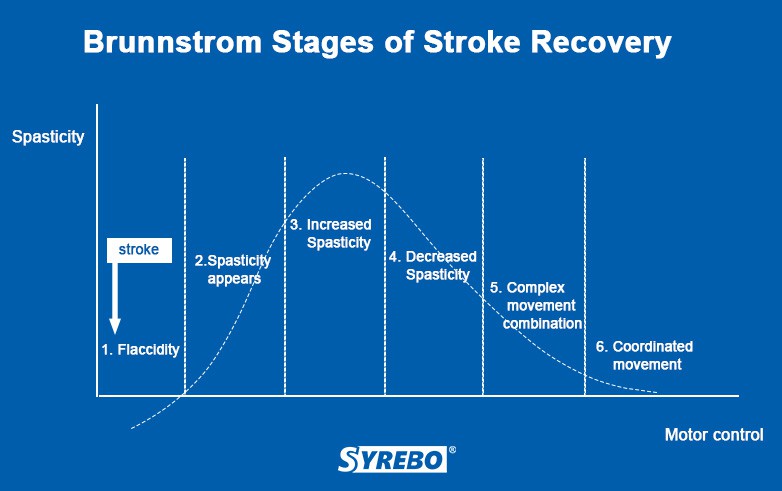
Stage 1: Flaccidity
There is a period of flaccidity immediately following a السكتة الدماغية. During this stage, the patient is completely unable to move spontaneously due to nerve damage. The intervention is needed to prevent unused muscles from atrophying.
What training can do in this stage
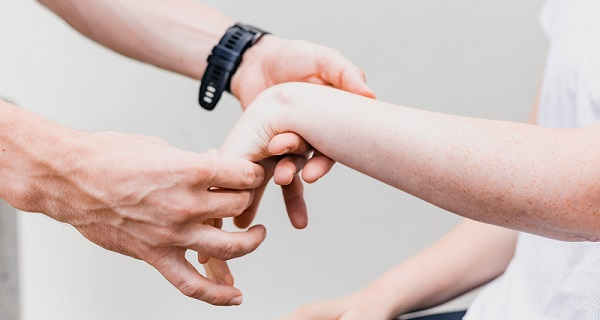
التدريب السلبيthat moves patient's affected hands and arms with the help of therapists is an important exercise in this stage. Through التدريب السلبي, the signals of movement are sent to the brain from muscles and skin, activating the motor nerves of the brain.
Stage 2: التشنج العضلي appears
Recovery begins with developing التشنج العضلي. Muscles may begin to tighten reflexively and have difficulty relaxing. It is still difficult for the patient to do the voluntary movement.
What training can do in this stage
Even though it is more difficult to move because of التشنج العضلي, التدريب السلبي is still crucial for patients in this stage. To avoid muscle stiffness affecting future activities, it is necessary to move the joints through slow التدريب السلبي.
Stage 3: Increased التشنج العضلي
In the third stage, the التشنج العضلي reaches its peak. Patients experience more discomfort and pain. At the same time, muscle synergies and weak voluntary movements begin to appear. If patients can use their synergies, they can complete some simple activities.
What training can do in this stage
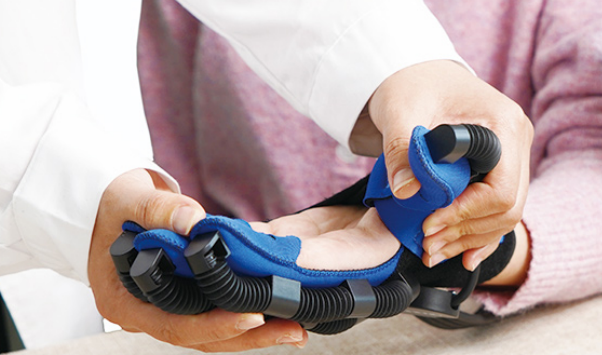
In addition to continuing التدريب السلبي, التدريب النشط can also be included appropriately. Patients can try to do some daily activities with the assistance of therapists and medical devices. The more signals sent from patient's brain, the stronger patient's muscles become. However, it is important to note that highly stressful activities should be avoided at this stage because of the increase in التشنج العضلي.
Stage 4: Decreased التشنج العضلي
The التشنج العضلي begins to decline. The patient's brain is becoming more and more adept at controlling muscles and using muscle coordination.
What training can do in this stage
During this stage, patients should focus on training the brain to control muscles. Since patients can act normal and control movements on a limited basis, patients can do different training to stimulate different areas of the brain. And, repeat these exercises to accelerate central nervous reshaping.
Stage 5: Complex movement combination
التشنج العضلي continues to decrease, and there is a greater ability for patients to move freely from the synergy pattern. The patient is able to perform more complex movements.
What training can do in this stage
From التدريب السلبي to التدريب النشط, it is the time to strengthen muscles. Add small weights to your exercises to build muscle endurance.

Stage 6: التشنج العضلي Disappears and coordination reappears
When you are in this stage, it means that your motor control is almost recovered and the التشنج العضلي completely disappears. You can practice coordination for more difficult activities.
What training can do in this stage
Keep strengthening patients' muscles with resistance training and add more complex exercises such as playing games, shuffling cards, etc. to improve coordination.
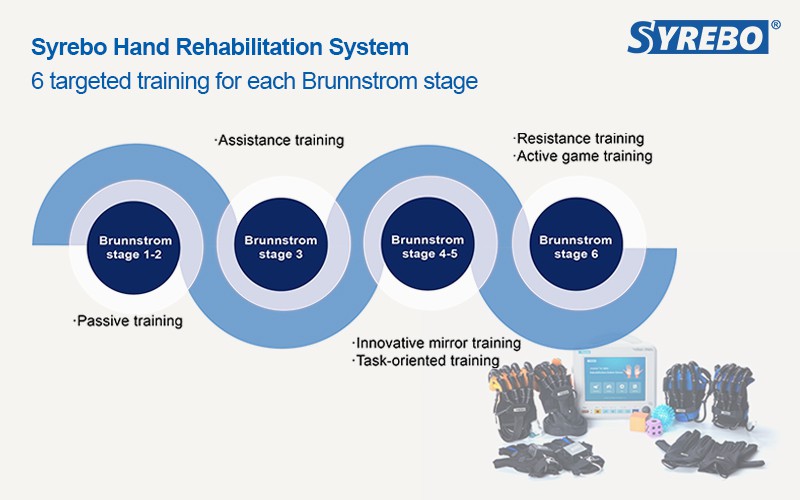
This six-stage recovery process from Signe Brunnstrom is a popular guide for both the therapist and patients. It is effective in clinical settings and can significantly enhance voluntary muscle movement after السكتة الدماغية. Based on the Brunnstrom stages, Syrebo hand إعادة التأهيل system for the clinic is innovated to help patients to relearn and recover hand motor functions via a series of passive and active exercises. It has 6 training modes covering all stages of hand إعادة التأهيل.
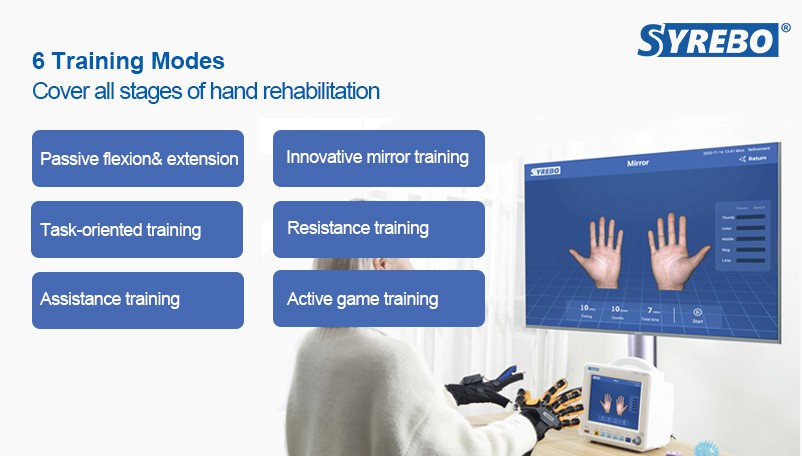
During Brunnstrom stages 1 and 2, therapists can use التدريب السلبي mode to help السكتة الدماغية patients do flexion and extension exercises to prevent muscle atrophy. In the third stage, the assistance training mode can capture the patient's weak active movement and assist the patient in completing the active movement. For critical stages 4 and 5, we specially incorporated innovative mirror training and task-oriented training to further enhance patients' learning process and re-educate patients to use hands during the activities of daily living. To improve hand coordination and strength, the Syrebo hand إعادة التأهيل system also provides patients with resistance training and active game training in the final stage.
Syrebo hand إعادة التأهيل system has already been applied in thousands of hospitals, and its clinical effect is recognized by lots of institutions. It is a good helper for therapists, greatly improving the efficiency of treatment. Contact us now to learn more about it: [email protected]